Our founder’s story
-

Undergrad years
When I came to the US from Europe at 17 to study biology at Cornell, I thought my greatest challenge was studying hard enough to get good grades. I had no idea what the challenges of being a woman scientist were all about.
-

Grad Student
When I became a graduate student in chemistry at MIT, I thought my greatest challenge was passing my qualifying and oral exams and writing my dissertation. I had never thought about how to balance being a great mother and scientist.
-

Professor
When I was an assistant professor, I thought my greatest challenge was getting tenure and funding for my research. I had never thought about the politics of academia and what came after tenure.
-

President of the Faculty Senate
When I became President of the Faculty Senate at Merrimack College, I finally understood the importance of being a scientist and a leaders but realized that I was not properly prepared for that role by my training as a scientist.
-

Executive Director
When I became Executive Director of the MIT Tata Center, I knew what I had to do outside my job: teach other women in STEMM all that I had learned along the way so that their journey could be a better one. That is when I began to teach leadership to women in the Boston Chapter of the Association for Women in Science.
-
Co-founder MIT LEAPS
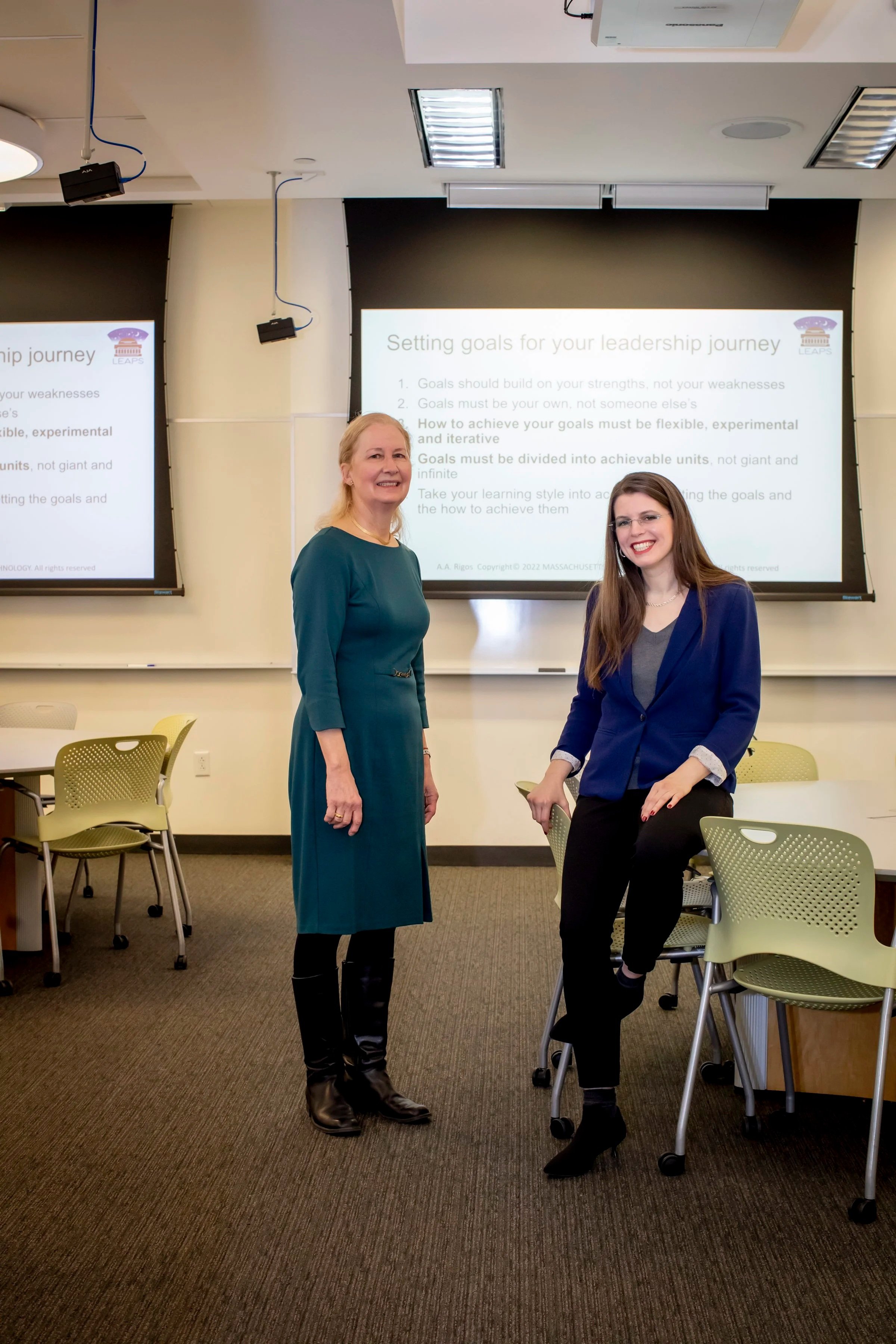
Professor Anna Frebel and I founded the MIT LEAdership and Professional Skills and Strategies (LEAPS) program in the Physics Department in 2019. In 2023, the MIT LEAPS Program was awarded the Irwin Sizer Award for the “Most Significant Improvement to MIT Education” by the MIT Graduate Student Council.
-
Social entrepreneur
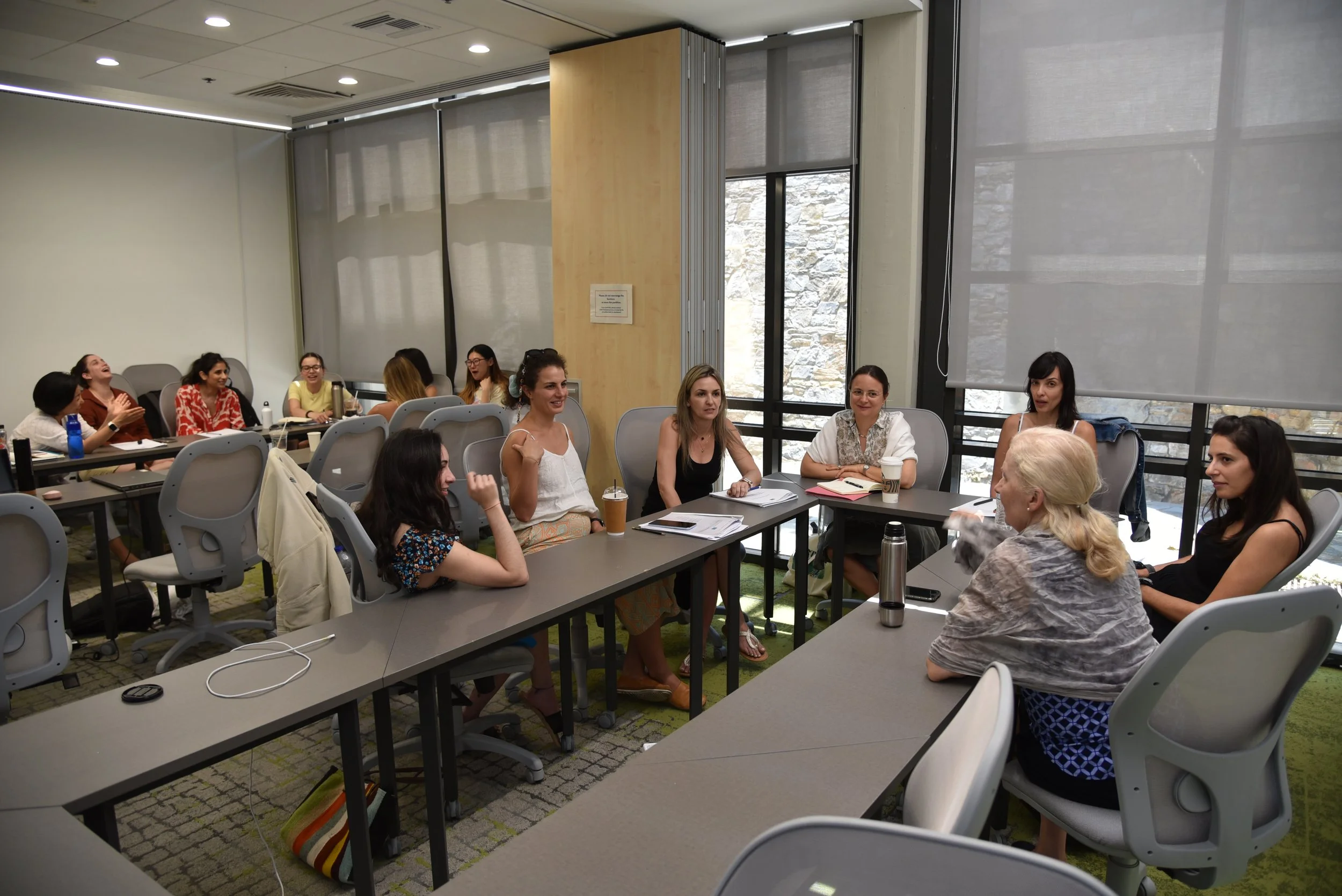
In 2021, I founded Epistimi (Greek for science and knowledge) in order to provide my MIT LEAPS course to women in STEMM globally. Our first in-person workshop took place at the American College of Greece in Athens in July 2023.
In 1994, as an associate professor in the department of chemistry at Merrimack College, Dr. Angeliki Diane Rigos began teaching a seminar on women in science. She was a member of the Women’s Studies Steering Committee which founded the Women’s Studies Program at Merrimack and became its first director.
In 2019, Angeliki started to offer workshops on “Leading the Energy Transition” for students and postdocs at the annual U.S. C3E (Clean Energy Education & Empowerment) “Women in Clean Energy” Symposium, a gathering of professional women across the clean energy spectrum.
At the same time, Angeliki co-founded the first leadership program for the Boston chapter of the Association for Women in Science (MASS AWIS). The inaugural program, launched in January 2019, was designed for women in early- and mid-career stages and aimed to both build leadership skills and professional presence, and to create a strong network of program alumnae. By 2022, the fourth year of the program, ~100 AWIS members had participated in the Program.
Already in late 2018, Angeliki had been introduced to Prof. Anna Frebel of MIT’s physics department. Both women had been working to help women graduate students navigate their STEMM journeys through informal meetings and occasional workshops.
They recognized that foundational training of professional skills was not available to grad students, let alone postdocs at MIT, and elsewhere. It thus became clear that a formal program would be needed to reach more graduate students and postdocs, and to provide a structured, systematic, and more in-depth preparation for their careers.
Creating a partnership to join forces, in Spring 2020, the MIT LEAPS graduate courses (8.396 and 8.397) on LEAdership and Professional strategies and Skills were offered for the first time, with postdocs also invited to join. A select group of postdocs were also chosen to learn the material alongside the regular participants but to also co-facilitate the classes with the instructors. This LEAPS postdoc cohort received mentoring and extra weekly training on the core concepts of each week and how to teach them. They were then able to co-teach/lead certain portions of selected classes, run group discussions and assist with personal work assessments. Successful co-facilitators will be able to teach this class themselves once they become faculty/group leaders, in consultation with the MIT LEAPS program. 2022 marked the third year of the program with over 200 MIT graduate students and postdocs alumni.
Spurred by the successes of all these programs and connections that Angeliki had created, the next logical step for her was to create a non-profit company for increased reach. Epistimi was born in 2021.
“Epistimi” means science or knowledge in Greek which embodies the mission of Epistimi: to focus on empowering women in STEMM (Science, Technology, Engineering, Math and Medicine) to better lead the world. Through a signature set of courses, workshops and individual mentorship, Epistimi now aims to develop STEMM women’s leadership competencies while they chart their leadership journey.
Epistimi hopes to fill the great need for programs taught by women in STEMM to women in STEMM that provide leadership and career development training to early career scientists and engineers in academia, industry, and beyond.
The magic of inspiration
According to the Cambridge Dictionary, inspiration is “someone or something that gives you ideas for doing something.” Inspiration works its magic when you meet a person or witness a situation that gives you that idea to act. Artists are inspired by a landscape, writers are inspired by life stories and scientists are inspired by a problem that needs a solution.
Looking back at my life, I see how one inspiration after another propelled my career. For many of the early inspirations, I had no control of my circumstances. My parents chose the countries and the schools I attended. When I was five years old, I began first grade in Beirut at the Ecole Protestante Pour Jeunes Filles where I learned French and Arabic. I do not remember my teacher but I do remember being inspired to teach my three year old sister every day after school what I had learned that day. Soon, my sister and I were chatting in Arabic with the maid and the neighbors while my parents had no idea what we were saying.
When I was seven, we moved to the Congo and there I found a new pupil, our cook, Cyrille. I was now learning the multiplication tables and I discovered that Cyrille did not know them. This deficiency had to be rectified so I spent every afternoon in the kitchen practicing the multiplication tables with Cyrille. This desire to share my knowledge with others is why I am still teaching.
Once I was an adult, I could choose countries, schools, employers, team members and friends so I could expand my circle of inspiration. What I did not appreciate until more recently is how inspiration can simmer below the surface, unconsciously, for years before the action takes place.
When I worked as an energy consultant at Levitan & Associates, a small consulting firm, I had the opportunity to closely observe the President and the Vice Presidents. The leadership differences between us were not based on large deltas in intelligence or education. We were all equally competent and they regularly made mistakes or wrong decisions. The real difference was in their confidence level compared to mine. Over time, their daily example prompted a confidence growth that eventually led to my founding a company of my own.
When I left my tenured position at Merrimack College and went back to MIT to run the Tata Center for Technology and Design, I had daily opportunities for inspiration. Reflecting on those two and a half years, I understand how deeply I was inspired by the nonprofit work of Ratan Tata and the Tata Trusts. I had never considered starting a nonprofit before meeting Mr. Tata and his colleague Manoj Kumar, who runs Social Alpha, a social entrepreneurship incubator. Mr. Tata never knew it but his example was the spark I needed to create Epistimi. And, we many not know it, but each of us is an inspiration to others when we follow our calling.