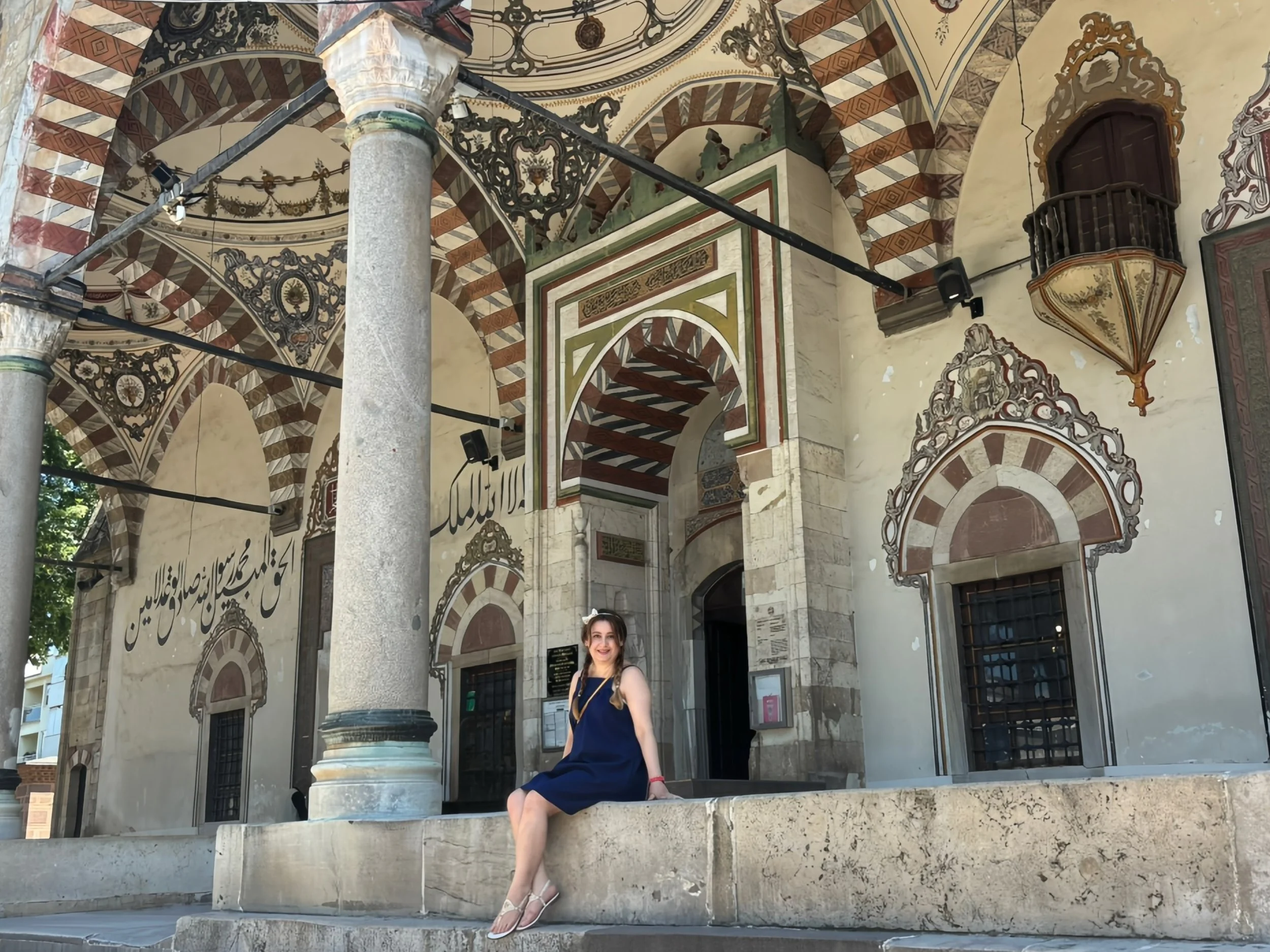
Dr. Yagmur Yegin at the Sultan Camii (Sultan Mosque), Manisa, Türkiye. Photo credit: Irmak Ravli
Dr. Yagmur Yegin has been both a participant and a co-facilitator in the MIT leadership program LEAPS. She discusses how the program enriched her collaboration, communication, and other leadership skills.
By Yagmur Yegin, with Patricia A. Maurice and Janet G. Hering
17 November 2026, DOI: 10.5281/zenodo.23880181
First taught in 2020, the MIT Leadership and Professional Strategies & Skills Training (LEAPS) program was created to help graduate students and postdoctoral researchers develop leadership, communication, and professional skills alongside rigorous scientific training [1]. LEAPS was also the basis and motivation for the Epistimi leadership program for women in STEMM [2], described by its founder, Angeliki Diane Rigos, in an early post in this blog series [3]. Bringing together researchers from different disciplines and career stages, LEAPS explores leadership, communication, professional development, career planning, networking, and the interpersonal dimensions of scientific work.
In 2022, while conducting postdoctoral research at MIT, Dr. Yagmur Yegin joined LEAPS as both a participant and a postdoctoral co-facilitator. She earned her M.S. and Ph.D. in Food Engineering from Texas A&M University and conducted postdoctoral research in Civil and Environmental Engineering at MIT. Her career has since expanded across scientific research, engineering, sustainability, science communication, mentoring, and community engagement [4].
Here, Yagmur reflects on how LEAPS shaped her understanding of leadership – and why leadership can begin long before one has a formal job title. Her thoughts echo those expressed in previous posts in this blog series on the books Labwork to Leadership [5] and Higher Expectations: How to Survive Academia, Make it Better for Others, and Transform the University [6] and on the Better Science Initiative [7].
Could you briefly describe LEAPS from your perspective as both a participant and a co-facilitator?
I experienced LEAPS from two perspectives at once: as someone learning and as someone helping create the learning environment for others. In spring 2022, I participated in the program while also serving as a postdoctoral co-facilitator, supporting small-group activities, class discussions, lectures, and assignments.
That dual perspective was particularly valuable because I learned not only from program leaders, including Anna Frebel and Angeliki Diane Rigos, but also from the researchers around me. Participants brought different disciplines, personalities, and professional experiences into the room. It made one lesson especially clear: there is no single formula for leadership.
Leadership is shaped by context, values, relationships, and the people involved. It shows up in how we communicate, make decisions, respond to uncertainty, collaborate, and create an environment where others can contribute.
What initially drew you to LEAPS, and which lessons have stayed with you?
At the time, I was deeply focused on becoming a better scientist, but I was increasingly aware that technical expertise alone would not define the kind of professional I wanted to become. I wanted to communicate more effectively across disciplines, build meaningful professional relationships, navigate ambiguity, and contribute to teams where I would not always be the most senior person nor the person with the most expertise.
I was also beginning to ask myself: What kind of leader do I want to be?
LEAPS gave me the opportunity to explore that question intentionally. Some lessons became even more meaningful after the program ended, as I moved through new teams, professional transitions, interdisciplinary collaborations, and situations without a clear answer.
Self-awareness has been one of the most enduring lessons. Leadership does not begin with becoming someone else; it begins with understanding who you are, what you value, how you communicate, and where you still have room to grow.
The program also reinforced the importance of listening, communicating, networking, cultural awareness, inclusive leadership, and understanding different leadership styles. I have become less comfortable describing these as “soft skills.” Listening carefully, building trust, navigating disagreement, and helping a team move forward are essential professional capabilities. For scientists and engineers, meaningful progress depends on connecting different forms of expertise.
What did you learn from being a co-facilitator?
One of the most important lessons was that facilitating is not the same as having all the answers. Sometimes leadership means asking the right question rather than providing the answer, sometimes it means stepping back so someone else can contribute, and sometimes it means recognizing a perspective that has not yet been heard.
Serving as a co-facilitator strengthened my ability to communicate with people from different scientific backgrounds and made me more attentive to the person on the other side of a conversation. I began asking myself: Who am I speaking to? What do they already know? What do they need from this conversation? What might prevent them from being heard?
Those questions continue to influence how I approach collaboration, mentoring, science communication, and situations where the technical answer may seem straightforward, but the human context is not.
How have you carried those lessons into your professional life?
The lessons from LEAPS have influenced how I approach interdisciplinary research, community engagement, mentoring, science communication, and professional transitions. What has stayed with me most is how much effective work depends on listening before trying to solve a problem.
One experience that particularly shaped this perspective was my involvement with Engineers Without Borders (EWB) [8], where I worked as part of an international engineering team on a sustainable water initiative serving approximately 5,000 residents across 12 villages in rural Kenya. The work required much more than technical knowledge. We collaborated with students, teachers, healthcare workers, community health promoters, farmers, and families, and developed bilingual English–Swahili educational resources addressing safe water, sanitation, hygiene, and food safety. The experience reminded me that even a technically sound solution may not be meaningful if it does not reflect the priorities and context of the people it is intended to serve.
That lesson applies far beyond community projects. It is equally relevant to academic collaborations and engineering teams: before trying to influence a situation, we need to understand it and listen to the people involved.
My transition from academic research into professional engineering reinforced this perspective. Moving into an engineering environment expanded my understanding of how scientific knowledge can become practical technology and scalable solutions. I saw firsthand that success depends not only on what you know, but also on how effectively you collaborate, communicate, adapt, and connect your expertise to a larger objective.
Has LEAPS influenced how you approach science communication and professional identity?
Absolutely. Over time, I have come to see science communication not simply as explaining science, but as building a bridge between knowledge and people. Whether I am discussing food systems, sustainability, emerging technologies, or interdisciplinary research, I enjoy translating complex ideas into language that helps people understand not only what we know, but why it matters.
That perspective has also shaped how I think about professional identity. To me, building a professional identity is not about creating an image. It is about having enough clarity to communicate what you care about, what you contribute, and where your work can create value.
Throughout my academic and professional journey, I have learned that meaningful impact often happens at the intersection of different disciplines, perspectives, and experiences. Whether conducting research, communicating scientific ideas, or collaborating with communities, I have come to value the ability to connect technical knowledge with real-world needs. This perspective has also shaped my understanding of leadership—not as a position or title, but as the ability to bring people together, learn from different viewpoints, and work toward shared goals.
LEAPS helped me recognize that thread and become more comfortable communicating it.
How has LEAPS influenced your approach to mentoring?
It encouraged me to become more intentional about how I show up professionally and how I can contribute to the growth of others. It made me more attentive to feedback, more conscious of assumptions, and more curious about perspectives different from my own.
My experience with the Association for Women in Science (AWIS) [9] reflects that evolution. I spent three years participating as a mentee before becoming interested in mentoring others. That progression reminded me that leadership and learning are not sequential stages. We can learn from someone while simultaneously creating opportunities for someone else.
For that reason, I increasingly believe that early-career researchers should not wait until they feel “senior enough” to practice leadership. Leadership can begin through listening carefully, supporting a colleague, sharing an opportunity, giving credit, asking a thoughtful question, or helping a team move forward.
What advice would you give institutions developing programs like LEAPS?
Leadership and professional development should be integrated into scientific training rather than treated as something researchers must figure out on their own. Graduate students and postdocs need opportunities to develop communication, mentoring, networking, conflict navigation, team dynamics, inclusive leadership, and career-transition skills alongside their technical expertise.
Programs are particularly valuable when they are practical and interactive – when participants can work through realistic situations, hear different perspectives, reflect on their experiences, and practice new approaches. Just as importantly, leadership development should not prescribe a single model of what a leader should look like. The goal is not to create identical leaders, but to give people frameworks, tools, and opportunities to develop an authentic approach grounded in their values, strengths, and aspirations.
Looking back, how has your understanding of leadership changed?
In 2022, I thought about leadership primarily as a collection of skills. Today, I think about it more as a responsibility: a responsibility for the relationships we build, the environments we create, and the possibilities we make available to others.
Scientific training often rewards certainty and correct answers, while professional life requires us to navigate ambiguity, competing priorities, and incomplete information. Leadership therefore requires the humility to say, “I don't know,” the curiosity to ask better questions, and the willingness to create an environment where others can do the same. My scientific training taught me how to investigate problems and develop technical solutions. My experiences beyond the laboratory taught me that the solution itself is only part of the equation. We must also understand who it serves, communicate its value, collaborate across boundaries, and consider how it can create meaningful impact.
Across these experiences, I have found myself most energized by work that connects disciplines, people, and real-world impact. That is the direction I want to continue pursuing: building a career that advances sustainability, communicates science with purpose, mentors emerging professionals, and creates opportunities for others to contribute.
I have also learned to be comfortable with the fact that meaningful careers are not always linear. For me, the most rewarding path is one that continues to challenge me, deepen my curiosity, and allow me to be useful to others.
What is the most important lesson you carry from LEAPS?
The ideas I encountered through LEAPS have become less like individual lessons and more like a framework I continue to use. The most enduring lesson is simple: leadership can begin before the title.
It can begin with listening, making space for another voice, asking a better question, accepting feedback, sharing an opportunity, giving someone credit, or simply being willing to learn.
Scientific careers are often measured through publications, discoveries, grants, awards, patents, and positions. Those achievements matter, but leadership adds another dimension: what we enable in the people and communities around us.
Looking back, LEAPS did not give me a finished definition of leadership – and I am grateful that it did not. Instead, it gave me a framework to keep asking better questions about how I work, how I communicate, and how I can contribute. Perhaps that is where leadership begins: not with having all the answers, but with being willing to keep asking better questions.
Questions for further thought and discussion:
· If leadership can begin before a formal title denoting a leader, what can leadership look like for a graduate student, postdoctoral researcher, or early-career professional – and how can institutions create more opportunities to practice it?
· Beyond technical expertise and measurable achievement, what capabilities – such as listening, communication, self-awareness, mentorship, and navigating differences – should be considered essential to scientific and engineering education?
· If there is no single model of effective leadership, how can mentors, institutions, and leadership programs help emerging scientists develop an authentic approach grounded in their values, strengths, and aspirations?
References and notes
[1] https://physics.mit.edu/academic-programs/subjects/mitleaps/ (Accessed November 2, 2026).
[4] https://www.linkedin.com/in/yagmur-yegin/
[5] https://www.epistimi.org/blog/when-do-we-learn-about-leadership
[7] https://www.epistimi.org/blog/better-science-initiative-sustainable-research-culture-for-all
[8] https://www.ewb-international.org
[9] https://awis.org