When do we learn about leadership?
Source: [1]
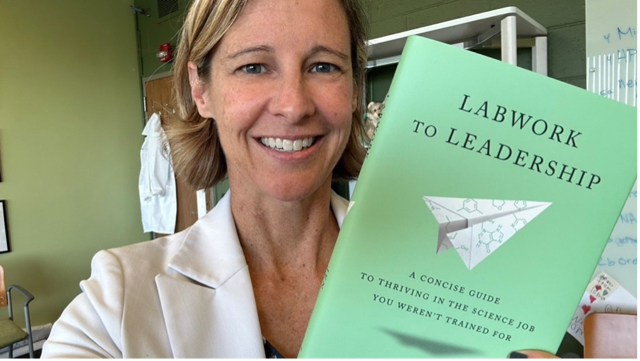
Prof. Jen Heemstra’s 2025 book “Labwork to Leadership” is one we wish that we had been able to read when starting out as assistant professors. Even senior women leaders in STEMM will be able to learn something from this book.
By Janet G. Hering with Patricia A. Maurice
14 April 2026, DOI: 10.5281/zenodo.19398077
Currently Chair of the Chemistry Department at Washington University at St. Louis, Jen Heemstra is the Charles Allen Thomas Professor of Chemistry and a Fellow of the American Association for Advancement of Science (AAAS) [2]. She is an outstanding role model for women in STEMM leadership. In her 2025 book Labwork to Leadership [3], Heemstra distills her experience to provide a “concise guide to thriving in the science job you weren’t trained for” (i.e., a leadership job). Like many of us, Heemstra learned her leadership skills on the job. She recognized early in her academic career that she was never trained in the management skills (such as conflict resolution) needed to lead a research group. Having overcome the challenge of a negative tenure vote (which was later reversed), she is especially sensitive to the importance of support networks and mentorship. Her book will help early career academics get off to a good start and will likely trigger reflection and perhaps some painful memories for mid-career and senior academics. Heemstra also emphasizes that leadership skills are important for all of us, whether or not we hold a formal leadership position. At the end of each chapter, Heemstra provides a list of action items that serves both as a quick summary of key points and a motivation for implementation.
Starting with self-leadership
In the first section of her book, Heemstra focuses on self-leadership as a fundamental building block for leading others. While many of the messages in this section echo popular business and management books, Heemstra filters these through her own experience and presents them in the context of working as a scientist in an academic setting. She also recognizes that we are all individuals with our own personalities and different strengths and weaknesses, which will influence our preferred leadership style.
Leading others as a team effort
Heemstra’s discussion of self-leadership sets the stage for her second section on leading others. Heemstra discusses leading others in an inclusive spirit, allowing her research group members opportunities to take ownership in the process of creating and implementing goals. She focuses on creating a working environment where everyone can thrive, a theme that has recurred in several of our previous posts [4-6]. Heemstra’s chapter on Ethical Leadership echoes some points we have made in several past posts [7-9] and is also clear about ambiguities that may arise in balancing competing interests and dealing with complex ethical issues. Effective communication is a central skill in leading others. Heemstra emphasizes the importance of transparency, while also recognizing that leaders will sometimes have to deal with situations where full transparency is not possible.
Passing it on
The third and final section of Heemstra’s book addresses how we can help others develop their own leadership skills. This includes providing opportunities for others to engage in leadership as well as helping them think through leadership challenges. In this section, Heemstra also confronts the challenges of bullying and harassment, including the tension between communicating outcomes and maintaining confidentiality. In the Introduction, Heemstra mentions her own personal experience of being bulled and harassed, which has clearly informed her dedication to ending and preventing unethical and inappropriate behavior. In her last chapter, Commitment, Heemstra returns to the lessons learned from her traumatic tenure story, which she considers “among the worst experiences of [her] life” (despite her eventual tenure promotion). She acknowledges the support she received from her own mentors. Although Heemstra’s book is written from an academic perspective, she highlights the importance of recognizing the value of careers beyond academia. She encourages her readers in academic leadership positions to define success by the “number of people who are able to pursue the career of their choice, rather than by the number who follow directly in [the reader’s] footsteps.” Heemstra closes by reminding her readers that “leadership skills are something that we can continually improve over time but will never truly master or perfect…”
Concluding comments and questions for further thought
Whether today’s doctoral students pursue careers within or beyond academia, the lessons in Labwork to Leadership will be invaluable for their future success. In contrast to when Heemstra (or we) were doctoral students, there are many resources on STEM leadership available. In addition to writing her book, Heemstra gave an excellent presentation for AWIS, the Association for Women in Science [10]. A recording of her presentation is available to AWIS members [11]. Leadership training programs for women who are doctoral students, postdocs, or junior faculty is offered by Epistimi [12], as described by Epistimi founder Angeliki Diane Rigos in previous posts [13, 14].
As senior women leaders in STEMM, we can encourage our junior colleagues to take advantage of leadership training opportunities, recognizing that leadership skills are essential in all professional (and many non-professional) endeavors. Heemstra’s book will also inspire us to look back at our own leadership journey, perhaps with some sympathy for our on-the-job leadership training.
In closing, here are a few questions to stimulate further thought and discussion:
· If you are a senior women leader in STEMM, when and how did you learn your leadership skills?
· If you are an early career researcher, have you considered participating in a leadership training program?
· Does your institution’s library have a copy of Heemstra's book? If not, you might consider requesting a copy and recommending it to students and junior colleagues.
Notes, links, and reference
[1] https://www.linkedin.com/pulse/trained-excel-lead-try-labwork-leadership-ya4re/ (Accessed March 31, 2026)
[2] https://chemistry.wustl.edu/people/jennifer-heemstra (accessed March 30, 2026)
[3] Heemstra, J. (2025) Labwork to Leadership: A concise guide to thriving in the science job you weren’t trained for, Harvard University Press, Cambridge, MA, 315 pp.
[6] https://www.epistimi.org/blog/better-science-initiative-sustainable-research-culture-for-all
[7] https://www.epistimi.org/blog/liar-liar-campus-on-fire-how-to-cope-with-dishonest-colleagues
[8] https://www.epistimi.org/blog/why-stemm-leaders-need-to-talk-seriously-about-ethics
[9] https://www.epistimi.org/blog/an-introduction-to-power-for-women-in-stemm-academic-leadership
[10] https://awis.org/
[11] https://awis.memberclicks.net/awis-webinar-with-dr-jen-heemstra-thriving-in-the-leadership-job-you-werent-really-trained-for (accessed March 31, 2026) Note that AWIS membership is required to access the recording.
[12] https://www.epistimi.org/