Perspectives of an Asian-American male ally
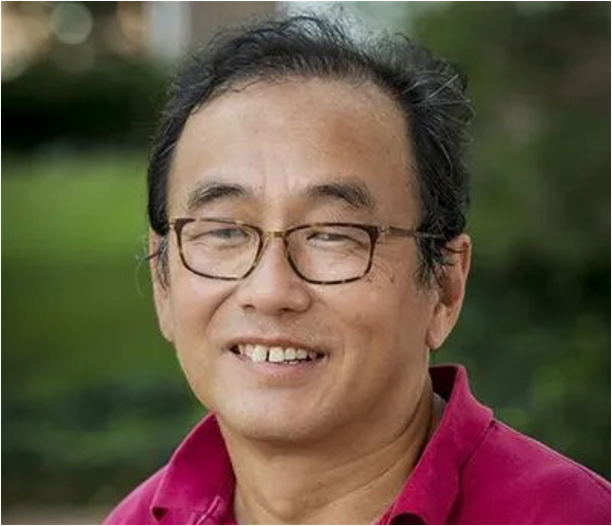
Professor Yu-Ping Chin (Photo credit: University of Delaware)
Professor Yu-Ping (Yo) Chin is a friend and colleague of the editors of this blog series, who has been an important ally for women in STEMM. He offers thoughts on his experience as an Asian-American academic and how it has shaped his perspective on supporting women, including senior women leaders.
By Yu-Ping Chin with Janet G. Hering and Patricia A. Maurice
22 September 2026, DOI: 10.5281/zenodo.22757061
Yu-Ping (Yo) Chin [1], the Edward C. Davis Professor in the Dept. of Civil, Construction, and Environmental Engineering at the University of Delaware (USA), is a distinguished environmental geochemist and environmental engineer who has collaborated with and mentored many women in science and engineering. Patricia worked with Yo on field and laboratory projects and considers him a good friend. Janet first met Yo at MIT where she had finished her doctoral degree, and he was a postdoctoral researcher (though in different research groups). She has stayed in contact with him, especially during his sabbatical stays in Switzerland. Given how many young women he has mentored, we asked him to share his thoughts and experiences as a ‘male ally’ for women in STEMM. We also asked him to describe how his experience as an Asian American informs his perspective on under-represented groups in STEMM leadership and to comment on this aspect of his career path. Although there are many Asian Americans in some areas of science and engineering, this demographic is under-represented in the geosciences and in many environmental disciplines.
How do you perceive faculty diversity in your fields of Earth Sciences and Environmental Engineering?
That’s an easy question for the Earth Sciences, which has been (and in places still is) a white male dominated field. When I was hired in 1991 at Ohio State University (OSU), I became the only Asian American (or Asian) professor in my department. I met Patricia shortly thereafter, and as she may remember from her visits to our department, diversity in both gender and ethnicity was sparse. Indeed, there was only one woman (a geophysicist) in the entire department for many years. It is difficult for an outsider to enter this world dominated by male, almost entirely white, colleagues. While there have been exceptional women geoscientists who have been pioneers in specific sub-fields such as geomicrobiology, geochemistry, and mineralogy [2], other fields, especially solid earth geology and geophysics, are still dominated by men [3]. Even in the biogeosciences, women are still playing catchup [4].
With respect to Environmental Engineering, the story is quite different. Many of my colleagues are women and departments are increasingly gender balanced. Throughout my career, starting in graduate school and my postdoctoral years, I have had women colleagues who have gone on to do great things (both of you are obvious examples here). I think Environmental Engineering is much more accepting of woman in their ranks, especially at higher level administrative positions (again both of you are perfect examples) where they can make a huge difference. Today, Environmental Engineering majors at the University of Delaware (UD) are overwhelmingly women (> 60% based upon my class rosters). Interestingly, the most prominent Asian scholars in environmental engineering are women [5]. One difference is that some are American born (as I am), while others immigrated from countries like China, Taiwan, or Korea. Regardless, all serve as outstanding role models for Asians and women alike. In this regard, Environmental Engineering has overcome many hurdles facing women and Asians. This trend must be maintained and there is always room for improvement, especially regarding other under-represented groups.
How did your experiences as an Asian American affect your education and professional development? Did you have any mentors who were Asian or Asian American?
I grew up in an entirely white community in Richmond, Virginia. Unlike now, Richmond was very “Southern” back then, and I was the only Asian in my school system from K-12. While this society was dominated by white Southern culture, the community accepted us because we were the only Asian family and my dad was a highly respected architect. I grew up playing football and basketball, hunting in the fall, and fishing and backpacking in the summer – typical activities for a Southern kid. These outdoor activities shaped me as a person, influencing my choice to study Earth and Environmental Sciences. When I began my studies at Columbia in New York City, the culture shock was immense. I was suddenly surrounded by Asian Americans from the Tri-State area and could not fit in because of my upbringing. Most of the Asian Americans who grew up in large Asian communities had different aspirations centered around wealth and prestige and pursued careers in business and medicine. I retreated to a circle of friends who were in large part not Asian. Despite that, I did become close friends with other Asian Americans from more distant places (e.g., the Midwest) who experienced the same culture shock and (like me) were not considered “Asian enough”. This rejection of Asian societal norms shaped me as I pursued a major in the geosciences and later Environmental Engineering in graduate school. Many Asian parents have a strong desire for their kid be a medical doctor – even after I got my job at OSU, my mom once said “You’re still young. You know you can still go to medical school and get your MD”. I think this was particularly true for me since I was their only son.
My four older sisters were my greatest source of inspiration. All excelled in what they ultimately chose as their careers, ranging from food chemistry to architecture. In graduate school, however, I had very few Asian mentors as most of the most influential environmental engineers were white men [6] including my advisor, Walt Weber. The one exception was Cary T. Chiou (of the US Geological Survey), who took me under his wing, supporting my intellectual development and the research on partitioning and polymers that ultimately resulted in my PhD dissertation. Cary and I are still friends, and he made it possible for me to give a seminar at National Cheng-Kung University in Taiwan where my dad taught architecture. That was quite an honor, especially because the Environmental Engineering department there is housed in the old architecture school where my dad had an office and taught.
What led you to become such a successful ally to women in STEMM? Do you see any parallels between experiences of women and Asian Americans in their career advancement?
Well, growing up in a household with four older sisters (and being the only male) had a significant impact on how I view my women colleagues. My spouse also comes from a female dominated family and she has had a significant impact on my career, especially regarding how I mentor my students. Aside from familial influences, my graduate student and postdoctoral research group cohort played an important role. At Michigan, Lynn Katz and I became fast friends, and it was her dedication to the field and her commitment to excellence that impressed me the most. She worked tirelessly in graduate school, earning an additional degree in Chemistry and keeping a cot in her office to nap during overnight experiments. Lynn is one of the earliest and most impactful researchers in the application of X-Ray absorption spectroscopy to adsorption processes in geomaterials and now holds the Alharthy Chair in Civil Engineering at the University of Texas, Austin. I can provide many examples of highly impactful women scientists (you two included) who have shaped not only my career, but those of my students as well. These shared experiences with my women colleagues have made me a strong ally.
I have mentored many women graduate students – all my NSF Graduate Research Fellows (GRF) and nearly all my EPA STAR Fellows have been women. I am immensely proud of their professional accomplishments, which have included post-graduate awards such as the NSF Postdoctoral Fellowships and even the highest award an early career scientist can receive (the PECASE Award to J. Ale Hakala at DOE).
Could you offer some examples of things you have done or seen other men do that have been particularly helpful for advancing women in STEMM? To what extent would these also be applicable to members of other underrepresented groups, like Asian Americans?
While my position has enabled me to help women as well as scientists and engineers of color advance their careers, I think it’s important to mentor all junior faculty (regardless of gender or race). My mentoring has included providing advice on negotiating the tenure to post-tenure transition and serving as a sounding board to help solve problems and overcome career barriers. Many of my older colleagues have been excellent role models for me in this regard by advising some of the most prominent women scientists and engineers in our field. For example, Janet’s PhD advisor François Morel and my postdoc advisor Phil Gschwend tirelessly championed and promoted their female mentees [7]. Among my contemporaries, colleagues such as Kris McNeill at ETH and Bill Arnold at the University of Minnesota have graduated women scientists and engineers who have pursued successful careers in both academia and industry.
The question of how to recruit and advise students from other underrepresented groups is significantly trickier (though I should note that Asian Americans are not underrepresented in all STEMM fields). As mentioned earlier, status is incredibly important in Asian American households, especially those from East Asia (which has given rise to the term “Tiger Parents”). Environmental Engineering is not an occupation that evokes “bragging rights” in the minds of many Asian American families (as my mom’s comment indicated). Even so, I have taught more Asians in my Environmental Engineering classes over the years at UD. I also want to distinguish between Americans of Asian descent and immigrants from Asia, where Environmental Engineering and the Earth Science are much more popular and respected. This is different for other underrepresented groups, however. Over the 9 or so years of teaching at UD, I have only had two African American and only one or two Latino students (all women incidentally), none of whom went to graduate school. So, while I believe that Environmental Engineering is a much more open community, I think part of the reason for the lack of participation among people of color is marketing. For entirely different reasons, however, the Earth Sciences are still an insular discipline where people of color have little access and experience. Over my career, I have only had experience with two African American men at OSU who pursued academic careers and two exceptional Latina women Earth scientists that have become superstars in their field (including my student J. Ale Hakala).
As a distinguished professor, do you have any thoughts on the current state of women in STEMM and members of other underrepresented groups in the US and abroad?
I think Environmental Engineering is on much better footing than the Earth Sciences with respect to women achieving parity with male colleagues. As stated earlier I see this in the classroom at UD where women majors outnumber their male counterparts. I wasn’t able to observe the gender breakdown at OSU because I was more focused on the graduate program and I taught a gigantic undergraduate introduction to Earth Science class (with few actual majors). However, the undergraduate committee at OSU was chaired by Anne Carey who did a fabulous job with recruitment and worked tirelessly to promote diversity in the Earth sciences. While things have greatly improved at OSU, there are still three times more male than female faculty members in the School of Earth Sciences; at UD there is greater parity. So, progress has been made in the Earth Sciences, but it is still spotty. With respect to Asian Americans in the Earth Sciences, a recent preprint report (not peer-reviewed yet) showed that they represent only 4% of recent PhDs, which is less that the 11-17% in other STEMM disciplines. Part of this I think is cultural; many Asian American parents yearn to have their child be a medical doctor or some type of engineer (definitely NOT environmental) or in business. Further, East and South Asian women in STEMM far out pace their Southeast Asian counterparts in STEMM fields [9]. So, while progress has been made, we have a long way to go to encourage other Asian Americans (not just East and South Asians) to enter our field. I hopefully did my part as one of my undergraduate advisees of Thai and Laotian origin (and a first-generation college student) just started her PhD at Princeton on an NSF GRF.
Have you experienced or witnessed incidents where Asian Americans in your disciplines or in Academic leadership have impeded by or broken through the ‘bamboo ceiling’?
I think the Asian women colleagues that I named previously have in many ways broken through the perceived ‘bamboo ceiling’ [10] by becoming leaders in the Environmental Engineering community. For example, Helen Hsu-Kim was a past chair of the prestigious Gordon Research Conference Environmental Sciences: Water. However, there are few Asians or Asian Americans (of either gender) from the Earth Sciences or Environmental Engineering in the US National Academies of Engineering or Sciences (NAE and NAS). So, in that sense, the ‘bamboo ceiling’ remains in place for many of us in both fields.
Do you have any other advice for senior women leaders on how to promote members of underrepresented groups in STEMM?
I have not myself taken on major academic leadership roles, so cannot speak as an insider. But I think it’s crucial to ensure that women coming up for promotion are treated fairly and objectively as well as providing emotional support when things go badly. In this regard, all the women that came up for promotion while I was chair of tenure/promotion committees at OSU or UD were promoted. I provided constructive tools to guide them through the process, which is essential.
Questions for further thought:
· How do you think the current funding climate in the US will affect the prospects for women and people of color to enter Earth Sciences and Environmental Engineering?
· How important has it been to your own career to have mentors with similar backgrounds, such as gender, race, ethnicity, etc.?
· What are you doing to ensure that women and people of color are treated fairly and objectively in the tenure and promotion process?
Notes and references
[1] https://ccee.udel.edu/faculty/yu-ping-chin/ Accessed July 28, 2026.
[2] Examples include Jill Banfield (University of California, Berkeley), Bess Ward (Princeton University), Dianne Newman (California Institute of Technology), Trish Dove (Virginia Tech), and Sue Brantley (Pennsylvania State University)
[3] Ranganathan, M., Lalk, E., Freese, L. M., Freilich, M. A., Wilcots, J., Duffy, M. L., & Shivamoggi, R. (2021). Trends in the representation of women among US geoscience faculty from 1999 to 2020: The long road toward gender parity. AGU Advances, 2(3), e2021AV000436
[4] Barnes, R. T., Wolford, M. A., Almaraz, M., & Cardarelli, E. L. (2024). Not enough: efforts to diversify biogeosciences benefit limited segment of society. Journal of Geophysical Research: Biogeosciences, 129(7), e2023JG007777.
[5] Examples include Helen Hsu-Kim (Duke University), Ching-Hua Huang (Georgia Institute of Technology), Young-shin Jun (Washington University), and Judy Zhang (Case Western University).
[6] Examples include the late Werner Stumm (ETH Zurich / Eawag), Jim Morgan (California Institute of Technology), and Charlie O’Melia (Johns Hopkins University).
[8] Among other, François Morel advised Diane McKnight (University of Colorado) and Phil Gschwend advised A. Lynn Roberts (Johns Hopkins University) and Allison MacKay (Ohio State University).
[9] Loi, H. (2024) “Asian Americans in STEM: Perceptions vs. Realities”, https://alltogether.swe.org/2024/05/asian-americans-in-stem-perceptions-vs-realities/, Accessed September 10, 2026.
[10] Ruttiman, J. (2009) “Breaking through the 'bamboo ceiling' for Asian American scientists”, Science, https://www.science.org/content/article/breaking-through-bamboo-ceiling-asian-american-scientists