
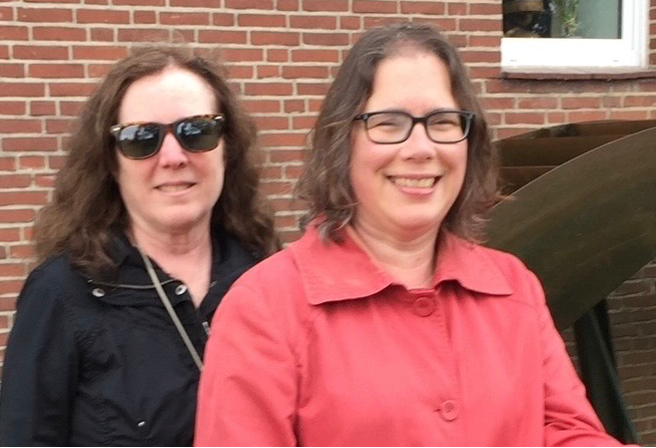
Prof. Em. Patricia Maurice (left) and Prof. Catherine Murphy (right) (Photo credit: T. Shaw)
Renowned chemist Catherine Murphy, Department Head at the University of Illinois, Urbana-Champaign, talks about the all-important job of being a Department Chair or Head.
By Catherine J. Murphy with Patricia A. Maurice
8 September 2026, DOI: 10.5281/zenodo.22044786
Professor Catherine Murphy is a chemist who works at the interface of materials chemistry, inorganic chemistry, biophysical chemistry and nanotechnology. She is an acknowledged leader in the investigation of nanoparticles [1]. Her many awards and recognitions include: the 2025 NANOSMAT Prize, the 2022 Centenary Prize of the Royal Society of Chemistry, the 2020 American Chemical Society Award in Inorganic Chemistry, the Linus Pauling Medal, and election to membership in the U.S. National Academy of Sciences. In addition to her groundbreaking research, she is coauthor of multiple editions of the widely used textbook Chemistry: The Central Science, now in its 15th edition [2]. Patricia had the great joy and honor of working with her for several years as members of a study group sponsored by the Hanse-Wissenschaftskolleg (HWK) Institute for Advanced Study, in Germany. Here, Prof. Murphy kindly answered some questions about her role as department Head at one of the world’s leading research universities.
Why did you decide to become Head of your department, despite already being extremely busy with cutting-edge research along with teaching and service?
The previous department Head worked on me for two years to make it sound attractive (you can totally keep your research going! It's fun to talk with alumni!). And, I am an alumna of the department (BS '86) so I do have more deep-seated loyalty to the place than the average faculty member. Plus, no one would else would do it, and somebody has to step up. I should also mention that here, the department Head does not have to teach in the classroom, so that does free up some time.
What are some of the greatest challenges you have faced as department Head, to date?
Many! COVID-19 response and aftermath; graduate student mental health distress; graduate student unionization; a federal government that is antagonistic towards science and universities; a local budget model that does not actually cover all the costs of our university work.
What are you most proud of in terms of your accomplishments as department Head, to date?
We have hired great faculty members, started a course in data science/machine learning for our undergraduate and graduate students, upgraded our undergraduate teaching labs, organized and streamlined some processes, gotten more active in talking with and listening to alumni (and did pull in some major gifts), and paid a great deal of attention to building a better community and climate within the department.
What advice would you give to other women considering taking on the role of department Chair or Head, in STEM?
Do have something in mind that you want to achieve, that is concrete. In my case that was getting data science into our curriculum and also paying more attention to the student experience. Don't just respond to external pressures, provide your own pressure to make good things happen.
If a woman is considering accepting an appointment to department Chair or Head, what should she focus on in negotiating the offer?
Here, there is not much to negotiate. All department heads and chairs in our College of Liberal Arts and Sciences get the same general deal; but the department itself provides extra resources for the head, to help keep their research going.
How do you manage to juggle your continued cutting-edge research with a time-consuming administrative position?
I am basically always on duty, 24/7.
What are your plans for the future?
Well, ha, once again no one else was willing to be Head here, so I am going to do another 5-year term! I hope at this point I have seen everything and can handle everything, but you never know. I will turn 70 not long after the next 5-year term, and my husband, who is already retired, is hoping I will actually retire too. Depends on how the science goes!
A few concluding thoughts:
Cathy, you make a tough job sound very doable, by focusing on what one wants to accomplish. One might say that you ‘put one foot in front of the other,’ which is crucial to good leadership in difficult times. Your list of accomplishments as department Head is substantial, especially in only five years. It’s also great to see you mention graduate student mental health, as we just published a post on that topic [2]. Thank you for sharing this part of your amazing story in science. Like many senior women leaders in STEMM, you are inspirational.
Questions for further thought:
· Dr. Murphy advises: “Don't just respond to external pressures, provide your own pressure to make good things happen.” How do you provide your own pressure in your career?
· Does “I am basically always on duty, 24/7” sound familiar to you? How do you deal with your own busy schedule?
· If you are at a university, how do you work to pay attention to the student experience?
References and notes:
[1] https://chemistry.illinois.edu/murphycj
[2] Brown , T.E., LeMay, H.E., Bursten, B.E., Murphy, C., Woodward, P., and Stoltzfus, M.E. (2023) Chemistry: The Central Science, 15th edition, Pearson, ISBN-13: 9780137542970.