
How to not internalize systemic dysfunction as personal failure
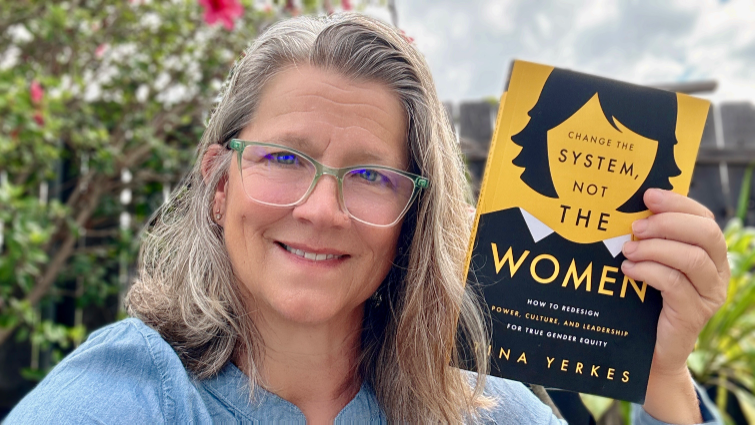
In “Change the System, Not the Women”, author Tina Yerkes holds leaders accountable for what their systems produce, not what they intend. She makes the case that equity is not a values exercise. It is a performance imperative.
By Tina Yerkes and Janet G. Hering with Patricia A. Maurice
6 October 2026, DOI: 10.5281/zenodo.23046243
As readers of this blog series are aware, our posts are promoted through LinkedIn. It was on LinkedIn that I (Janet) first became aware of Tina Yerkes [1] and her new book, Change the System, Not the Women [2]. Through the book page on her website, Tina offers a free copy of the first chapter of her book [3]. After reading this, I reached out to Tina about contributing to this blog series. She generously sent an advance copy of her book to me and Patricia. Both of us were impressed at how Tina builds on her own leadership experience – and the resistance that her leadership triggered – to identify systemic barriers to women’s progress. We also noted that Tina’s book picks up many of the points that we addressed in our previous posts, for example, on who benefits from existing systems [4], power dynamics [5], facing leadership challenges [6] and taking on a leadership position [7], and dealing with dishonest colleagues [8].
Tina’s experience spans a variety of fields and sectors, including environmental conservation, public health, international sustainability, and social impact. She brings the rigor of her PhD in Zoology and her executive training at Harvard and the Kellogg School of Management at Northwestern University to her analysis of organizational management. On this basis, she provides a framework for leaders to move from coaching women to survive broken systems to building organizations that can benefit from critical thinking and disruptive leadership.
Here, Tina kindly answered some of our questions about her book and her broader work.
What would you say are the key messages of your book?
The book challenges the belief that women must adapt to succeed at work – women do NOT have to change. Using women's lived experiences as a lens, I expose how workplace systems actually operate and show leaders how to diagnose and redesign their own workplaces to improve performance, retention, and leadership effectiveness. The book is heavily focused on naming and diagnosing systemic issues because of the denial that exists around them. With this background, the book outlines a framework of four pillars (decision architecture, power and accountability, resource flow, and signal design) that will allow organizations to build resilience and to succeed in complex, dynamic environments that “demand more from leadership systems than simple replication of past patterns”.
What was your writing process like? Do you have any tips for aspiring authors?
It was a bit chaotic frankly – I had never written anything longer than peer-reviewed scientific articles or articles for the popular press, so getting the arc and order was very difficult. Eventually, I was advised just to start writing and let the editorial process clean it up from there. So, I sat down and wrote all my ‘stories’ first. Then I described the thought leadership around the systemic patterns and challenges that women had to overcome. After I married the stories to the diagnosis and pattern, I ordered the material into chapters the best I could and sent it off! I had no idea there were so many rounds of editorial work – months – not because they needed to re-do much, but because they were very meticulous. The same advice I was given can be beneficial to other aspiring authors, with the additional caution to expect a long process.
You also have other roles, as a keynote speaker, consultant, and coach. How did you balance these activities with your writing?
I write on the weekend – I basically forced myself to get into this habit. This routine allows me to avoid fragmenting my efforts and to complete my writing work. So, every weekend I write my Substack, my LinkedIn, my Instagram and Facebook posts, schedule it all, and forget it! During the week I work on consulting preparation, workshop and webinar updates, and other contracts I manage.
You made the first introductory chapter of your book available in advance of publication. What feedback did you get from that?
I have gotten very positive feedback from the first chapter. I also shared a few advanced review copies (ARCs), which resulted in endorsements or the book as well as the opportunity to write this post.
What do you hope that your book will accomplish?
Awareness, conversation and change, which sounds simple but is actually a huge challenge. I hope that women will understand their experiences sufficiently to stop internalizing them. This would allow women to evaluate whether their organization is capable of genuine change and to make deliberate decisions about what they are willing to invest, what they need to protect, and when it is time to redirect their talent elsewhere. I hope that leaders would redesign their organizations to make authority explicit, visible, and accountable. I am convinced that such redesigned organizations would be more resilient and successful as well as more attractive to women leaders.
How should readers contact you if they have questions or want to pursue some of the recommendations in your book?
There’s a contact form and email address on my website [3] or readers could send me a direct message (DM) through LinkedIn [1].
Conclusions and questions for further thought
Although Tina’s book does not focus on academic institutions per se, many of her observations will likely ring true for senior academic women. Tina points out that “Most modern organizational structures were not designed in deliberate opposition to women. They were not created with the explicit intention of excluding or disadvantaging female leaders. They were designed in the absence of women.” She argues that the resulting structural blindness “operates invisibly, woven so deeply into the fabric of how things work that it becomes nearly impossible to see from inside the system itself.” Her book illuminates these invisible operations, offering insights into leverage points for systemic change.
Without suggesting that women adapt to dysfunctional systems, Tina’s book does encourage women to observe and evaluate their working conditions carefully as a basis for deciding on their best course of action. She emphasizes that such decisions should be made deliberately, based on evidence rather than hope and with attention to both opportunity and cost.
In closing, here are a few questions to stimulate further thought and discussion:
· Does your leadership trigger resistance in the form of offers for coaching or suggestions that your style is counter-productive? How do you react to this?
· Have you observed talented women leaving your organization? How has this been rationalized by the organization?
· Are you in a leadership position where you could help to redesign your organization? How would you go about this?
Notes, links, and references
[1] https://www.linkedin.com/in/tina-yerkes-phd/
[2] Yerkes, T. (2026) Change the System, Not the Women, Fast Company Press. (find booksellers on Google books).
[3] https://www.tinayerkes.com/book
[4] https://www.epistimi.org/blog/who-benefits-from-the-lack-of-advancement-of-women-in-stemm-academics
[5] https://www.epistimi.org/blog/an-introduction-to-power-for-women-in-stemm-academic-leadership
[6] https://www.epistimi.org/blog/preparing-to-lead-effectively-through-emerging-challenges
[7] https://www.epistimi.org/blog/embarking-on-a-new-leadership-position
[8] https://www.epistimi.org/blog/liar-liar-campus-on-fire-how-to-cope-with-dishonest-colleagues