
The Daruma and need of women in STEMM for resilience
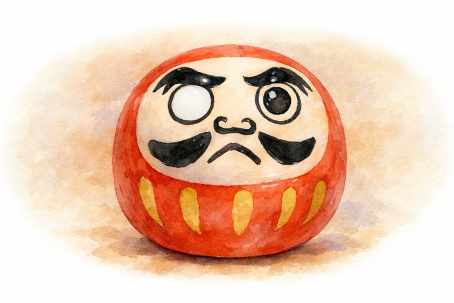
Source: Photo by P. Maurice, edited to a painted style using Copilot.
The Daruma symbolizes the Japanese ‘fall down seven times, stand up eight’ philosophy of resilience. Women in STEMM need to be resilient, both individually and collectively.
By Patricia A. Maurice and Janet G. Hering
23 June 2026, DOI: 10.5281/zenodo.20681082
Anyone who travels in Japan is likely to encounter the rotund red Daruma dolls which are ubiquitous and widely recognized as symbols of resilience. Traditionally, the Daruma devotee will paint in one eye when they set a goal, then the other when the goal is achieved. The round Darumas are weighted so that they right themselves automatically when tipped over, symbolizing the philosophy of ‘fall down seven times, stand up eight’. Darumas are widely used by students, politicians, businessmen, and other people for whom achieving a goal is of great importance.
Legend has it that Daruma dolls are representative of Bodhidharma (or “Damo” in Chinese), a Buddhist monk believed to have spent nine years meditating in a cave [1]. Over time, his arms and legs atrophied so much that they fell off. Bodhidharma is believed to have brought Zen Buddhism from India to China, from where it eventually made its way to Japan.
Women in STEMM need resilience throughout our careers
Considering the many challenges most women in STEMM experience throughout our education and careers, we each need to be resilient. STEMM has traditionally been male dominated, as are many STEMM workplaces today. To succeed in STEMM, women thus need great reserves of inner strength, often beyond those of their male colleagues.
The Women in STEM Network [2] describes resilience well: “For women in STEM, resilience means more than enduring long hours in labs or learning complex coding languages. It means working through implicit bias, being underestimated, and often being the only woman in a classroom, team, or boardroom. Resilience is about finding ways to thrive when the environment is not always designed to support you.”
To pursue a STEMM education, a young woman needs to be resilient through the ‘negative drumbeats’ of society telling her that girls cannot succeed [3]. Girls’ confidence, especially in math, can be negatively affected by gender stereotypes promulgated by peers, parents, teachers, and school counselors [4]. As a woman’s education and career advances, she often needs to be resilient in the face of added challenges such as pregnancy and childbirth, academic service work [5, 6], and isolation in male-dominated fields. Numerous studies have demonstrated that motherhood, especially pre-tenure, can negatively impact women’s academic careers in STEMM, much more so than does fatherhood [7].
One extra hurdle many women face is the double-edged sword of perfectionism. Perfectionism can help drive our careers forward in STEMM; indeed, for science to be beneficial it needs to be done ethically and rigorously. According to Ellen Hendriksen, clinical psychologist and author the book How to Be Enough: Self-Acceptance for Self-Critics and Perfectionists, “Perfectionism has a healthy heart because its core is conscientiousness, which is the tendency to be responsible and diligent, to do things well and thoroughly, to care deeply. Research has shown that conscientiousness is the No. 1 trait for both objective and subjective success in life” [8, 9].
But perfectionism can also have its drawbacks. Hendrickson goes on to explain that “if we define failure as not meeting standards, ours or those of others, what will often happen is that we either get overwhelmed or intimidated, and we then avoid our task. Or we’ll try, but we’ll fail, not because we were incapable but because our standards were unrealistic. Either way, self-criticism comes in and leaves us feeling inadequate or not good enough.” Self-criticism is one element of the ‘imposter syndrome’ that many women in STEMM experience. Perfectionism and self-criticism can also cause women to delay publications or to not seek out high profile publication venues, grants, and career opportunities. Eventually, perfectionism can lead to burnout and even physical illness.
When we do succeed, we can be put on a pedestal, but that means we are alone [8]. Many women in STEMM, especially senior leaders, are already isolated without this added pedestal effect. Being put on a pedestal also can lead to ‘tallest poppy syndrome”, which occurs when the poppy (i.e., the successful person) is cut down because they stand out from others in the field [10]. Sometimes, students and colleagues can be turned off by the demands of a perfectionist, especially when that person is a woman who is ‘supposed’ to be kind and nurturing [11]. Perfectionism can also lead to mental and physical health problems such as anxiety, insomnia, and depression. An education and a career in STEMM are difficult enough without the added challenges women face. Like the Daruma, we are certain to take many falls, but we need to be resilient enough to keep standing back up again.
The community of women in STEMM needs resilience now as much as ever
Beyond the challenges individuals face, the community of women in STEMM must confront constant, evolving gender-related challenges. For Janet and Patricia, as emerita looking back over the past half century, it can sometimes feel like every time women seem to be taking a big step forward, we get pushed back again. Girls in Afghanistan began to be educated, but then the Taliban returned to power, and things went right back to the dark ages. Numbers of women in academic positions were increasing, but the COVID pandemic caused many to quit their jobs to take care of children sent home from school. Women started to be included more in medical research and databases focusing on women were growing. However, they are disappearing from the internet as part of the current US administration’s purge of anything with even a hint of being gender related. This is a major setback at a time when the potential for gender bias in big data sets is highlighted by the recent explosion of AI; it is likely to affect women’s health and safety. While women have broken glass ceilings, many have fallen victim to ‘tallest poppy’ syndrome, sometimes after being targeted by groups opposed to women working in non-traditional fields, or anything outside the home.
The 2025 Lovelace Report [12] documents the drain of women from the tech industry. This report, by We are Women and Oliver Wyman, concluded that “Between 40,000 and 60,000 women leave the UK’s tech sector every year, costing the economy an estimated £2 to £3.5 billion annually. This isn’t a pipeline problem — it’s a system failure.” Using data from the Office for National Statistics, they found that in 2024, “the rate at which women left the UK information and communication sector was more than double that of men.”
Through a survey of more than 500 mid-to senior-level women in tech, they documented the reasons for women leaving the industry, including: lack of advancement opportunity (25%), lack of recognition (17%), inadequate pay (15%), dissatisfaction with company culture and working conditions (8%), and absence of role models or a supportive network (8%) [12]. None of these issues come as a surprise to us, as senior women leaders in STEMM, although we did not work in the tech sector.
Women leaving the tech industry, even after establishing themselves, mirrors trends in many (although not all) other STEMM workplaces. According to a 2023 Nature article [13]: “Research suggests that after establishing their academic careers in STEM, women are two times more likely to leave compared with men”. Think about this: for a woman even to have begun a STEM career, she must have been highly resilient; yet she still gets knocked down to the point of not rising up again. Hopefully, many of these women have found ways to stand back up in different venues.
Senior women leaders in STEMM need to continue supporting one another
Belonging to a group in which one can find help, camaraderie, and support is an essential part of cultivating resilience. This was one of our goals when we founded this blog. We hope that each of our readers will find ways to keep persevering. Please feel free to reach out to us if you have a suggestion of another useful topic we might cover, or if you would like to contribute a post that will help others gain resilience. Even the Daruma dolls do not stand alone — there are many Daruma and they are an integral part of Japanese culture.
Questions for further consideration
· Have you ever been to Japan? If so, have you ever purchased a Daruma doll?
· How have you manifested resilience in your own life and career?
· How can we better help young women to culture resilience in their lives?
· What more can senior women leaders do to help foster resilience within our communities, especially in challenging times?
References
[1] https://japan-forward.com/theres-more-to-the-daruma-than-meets-the-eye/ (Accessed May 4, 2026).
[2] Women in STEM Network (2025) “How Women In STEM Build Resilience And Strength In Male Dominated Fields” https://womeninstemnetwork.com/resilience-women-stem/ (Accessed May 5, 2026).
[3] Patricia A. Maurice, 2025. Do Science Like a Girl: how women in science are changing the world. M&M Honey Farms Press, Edwardsburg MI, USA, ISBN 9781300277453
[4] UNESCO (2022). Missing out on half of the world’s potential: fewer female than male top achievers in mathematics and science want a career in these fields. https://unesdoc.unesco.org/ark:/48223/pf0000381324.
[6] Järvinen, M., & Mik-Meyer, N. (2025). “Giving and Receiving: Gendered Service Work in Academia.” Current Sociology,73(3), 302-320. https://doi.org/10.1177/00113921231224754
[7] https://www.epistimi.org/blog/how-becoming-a-mother-made-me-a-better-professor
[8] Mineo, L. (2025) “The lie that taints perfectionism” Harvard Gazette, https://news.harvard.edu/gazette/story/2025/02/when-is-perfectionism-unhealthy/ (Accessed May 5, 2026).
[9] Hendricksen, E. (2025). How to Be Enough: Self-Acceptance for Self-Critics and Perfectionists. St. Martin’s Essentials. 320 pp.
[10] Billan, R. and Humber, T. (2018) “The Tallest Poppy: High-performing women pay a steep price for success,” Women of Influence, https://www.womenofinfluence.ca/2018/09/24/the-tallest-poppy-high-performing-women-pay-a-steep-price-for-success/ (Accessed June 13, 2026).
[12] 2025 Lovelace Report. https://wearetechwomen.com/2025-lovelace-report/ (Accessed June 13, 2026).
[13] Boivin, N., Täuber, S., Beisiegel, U. et al. (2024). Sexism in academia is bad for science and a waste of public funding. Nat Rev Mater 9, 1–3. https://doi.org/10.1038/s41578-023-00624-3 (not open access). For an open access version, see: Boivin, N., Hering, J.G., Täuber, S. and Keller, U. (2024) “How your money is helping subsidise sexism in academia – and what you can do about it”, https://theconversation.com/how-your-money-is-helping-subsidise-sexism-in-academia-and-what-you-can-do-about-it-218347 (Accessed June 13, 2026).