
Senior women leaders need to be aware of the complexities of academic power abuse. Good leaders must recognize, investigate, and discourage abuses with fairness and with the understanding that power is not unidirectional.
By Janet G. Hering and Patricia A. Maurice
20 October 2026, DOI: 10.5281/zenodo.23386414
There are many forms of academic power abuse, from mobbing and blatant bullying to failing to properly grant co-authorship to pushing junior colleagues to take on more than their fair share of academic housework [1]. Mobbing and bullying [2, 3] are unfortunate realities in academia, arising from pressures on universities (as institutions), on faculty, and on early career researchers (ECRs) and reflecting hierarchical structures with strong power imbalances and weak governance. Mobbing and bullying may follow multiple pathways, not limited to a single direction. In academia, professors hold intermediate positions, with power over more junior colleagues but subject to the power held by academic administration and leadership. Individual professors, especially women or members of under-represented groups, may also be subject to collective pressure by groups of less or equally powerful individuals (i.e., students or colleagues).
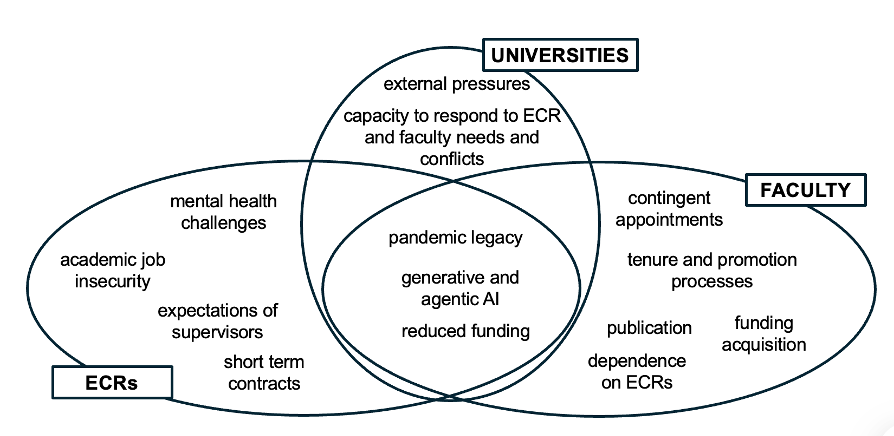
The graphic illustrates pressures that affect individual and institutional actors in academia. Some pressures affect not only universities but also their faculty and ECRs. These include agentic and generative artificial intelligence (AI), which undermine conventional practices in teaching and research and require policy responses from institutions [4]. The legacy of the COVID 19 pandemic has increased awareness of mental health issues [5] on campuses and increased demand for mental health services. Reduced funding is a common pressure world-wide. Other pressures affect mainly faculty (e.g., the tenure and promotion process) or ECRs (e.g., the insecurity of working on short-term contracts).
Pressures on ECRs and faculty
Media reports of mobbing and/or bullying often focus on the experiences of ECRs who experience bullying by supervisors during their doctoral or postdoctoral activities, but who may report it only after leaving their research group or institution. For ECRs, the mismatch between supply and demand in the academic job market is a source of anxiety and frustration. The academic job market is simply insufficient to absorb all the ECRs who would like to remain in academics after their doctoral or postdoctoral training [6]. Two OECD reports (in 2021 [7] and 2023 [8]) have highlighted the precarity of ECRs and recommended training for diverse career pathways, pointing out that only ca. 10% of incoming doctoral students will ultimately attain a professorial position.
The issues of precarity are also increasingly affecting faculty, especially in the US where many faculty who would likely have been in tenure-track or tenured positions in the past are now hired on short-term and often part-time ‘contingent’ contracts. According to the American Association of University Professors (AAUP) [9], “The percentage of faculty members holding contingent appointments ranged from about 51 percent among Research I universities to about 83 percent among associate’s colleges.” Contingent faculty can easily fall prey to pressures to take on more responsibilities and work longer hours than they are being paid for because they do not have job security. Such pressures are forms of bullying. Moreover, several US states have moved to weaken tenure protections (e.g., Texas, Kentucky, Kansas) or even eliminate tenure going forward (Oklahoma) [10]. This is part of efforts to restrict academic freedoms, a form of societal bullying.
At the same time, expectations on professors and their performance have become increasingly burdensome and unrealistic, especially during the tenure process. Publishing in high profile journals such as Nature and Science comes to be seen as a prerequisite for career advancement. Professors feel obligated to generate visibility for their work, often through social media. It is commonplace for senior professors, if they are honest, to admit that their own pre-tenure accomplishments would not be sufficient to earn them tenure today.
Even tenured faculty are not immune from flawed, or even deliberately misused, administrative investigations. Gender bias [11] can affect how such investigations are initiated and carried out as well as their ultimate outcomes, up to and including dismissal [12].
Consequences of pressures on ECRs and faculty
In response to these pressures, ECRs and more senior faculty may take out their frustrations on each other. In these conflicts, the role of systemic deficits in universities tends to be underestimated or even ignored. The incentives in institutions (not only universities but also funding agencies and professional societies) glorify individual accomplishment and devalue the contributions made by other team members. This can put the interests of the team leader, usually a professor, in his or her professional advancement at odds with the interests and well-being of ECR team members. Although many professors have the personal integrity and ethics to resist such conflicts of interest, some will act inappropriately toward ECRs who are dependent on them. This dependency, especially for ECRs hoping to pursue an academic career [13], may make them less likely to challenge inappropriate behavior and more responsive to academic incentives that may not serve their own longer-term interests.
Although not as widely discussed or understood, ‘upward bullying’ can also occur [14], particularly if the professor is perceived as weak or vulnerable. Unconscious bias and gender-based expectations may result in female faculty bearing the brunt of ECR frustrations [15]. Even more unfortunately, ECR complaints against female faculty may be supported or even prompted by faculty colleagues or administrators, not based on the merits of the complaints, but in the interest of suppressing a ‘difficult’ or too-successful colleague [16]. Although men can also be subject to the phenomenon of pruning a ‘tallest poppy’, gender-biased expectations often result in the preferential targeting of women [17].
Institutional responsibilities
Given the close working relationships and complicated inter-dependencies in academia, conflicts in such situations tend to conflate issues of scientific integrity with those of supervisory responsibilities. Thus, it is essential that universities, as institutions, exercise good governance and have adequate and appropriate measures in place to ensure that all parties to a conflict are treated fairly, that their justifiable concerns are addressed and that their personal and professional well-being are protected. Not every complaint is justified, and false charges can have devastating personal and professional impacts.
As recent reports [18] have illustrated, processes within universities have not been adequate to address the challenges of mobbing, bullying, and harassment. Trust in university processes and procedures is lacking. Building trust will require a clear commitment to the principles of good governance, including transparency and accountability, as well as a collective commitment by faculty and administration to ethical behavior and the well-being of ECRs. An open culture of reflection and critical thinking must be embraced, allowing all members of the university community to express their ethical concerns without fear of retribution and encouraging faculty to take collective responsibility for the well-being of students, doctoral students, and postdocs [19].
Institutional leaders must be especially aware of and on guard against the possibility of academic mobbing in which the mobbing target is systematically isolated, humiliated, and pressured to leave the institution. Since academic mobbing often proceeds though rumor and innuendo and is facilitated through informal power networks, academic leaders need to be especially attentive to due diligence and due process, ensuring that allegations are verified and all parties are heard. The weaponization of misconduct procedures against individuals [12] must be rigorously guarded against.
In many universities around the world, students, staff, and/or faculty are unionized. Unions can address academic power abuses and bullying through victim advocacy, negotiating formalized policies, and/or providing parties involved with legal or professional representation. The involvement of a union does not necessarily prevent academic abuses or guarantee fair resolutions. Professional associations, like the AAUP, also provide helpful and informative online resources [20]
Concluding comments and questions for further thought
Although individuals are ultimately responsible for their own actions, institutions bear responsibility for establishing, perpetuating, and implementing incentive systems that encourage hyper-competition and discourage adequate attention to the well-being of ECRs [21]. This includes turning a blind eye to the informal power structures that are prevalent in academia [22]. Profound self-reflection on the part of universities and major changes in academic incentive systems are needed to create a working environment that benefits all members of the academic community [23].
What can our readers do? Raise awareness, set a good example through your own behavior [24], know your institution’s policies [25] on bullying and other academic power abuses and work to ensure they are meaningful and up-to-date, do the same for any societies or journals you are involved with, don’t simply ‘look the other way’ when you observe an abuse of power, and share your experiences in public forums. If you are interested in writing a guest post on the topic for this blog, contact us at: epistimiblog@gmail.com.
In closing, here are a few questions to stimulate further thought and discussion:
· How do you perceive pressures on different constituencies within academia as well as on the university as an institution?
· Are you aware of cases of academic mobbing within your institution?
· How do you perceive the level of trust within your institution regarding how accusations of bullying, mobbing and harassment are handled?
Notes, links, and references
[2] The terms mobbing and bullying are sometimes used interchangeably but also have different meanings in the US and Europe. Bullying usually refers to treatment directed by someone with more power against someone(s) with less power and mobbing as treatment directed by a group with less (formal) power against someone with more (formal) power. The latter case can be complicated, however, if the person with more (formal) power (e.g., a female professor) is then mobbed and/or bullied by her colleagues and/or administrative leadership.
[3] Westhues, K. (2025) “Top Twenty Takeaways from Research on Workplace Mobbing”, J. Workplace Mobbing, https://journalofworkplacemobbing.org/index.php/jwm/article/view/403.
[4] https://www.epistimi.org/blog/development-of-generative-ai-policy-at-lund-university
[6] Hering, J.G. (2023) “Pipelines are not meant for people”, Strukturelle, https://www.strukturelle.ch/en/post/pipelines-are-not-meant-for-people
[7] OECD (2021) “Reducing the Precarity of Academic Research Careers”, OECD Science, Technology, and Industry Policy Papers, No. 113, https://www.oecd.org/en/publications/2021/05/reducing-the-precarity-of-academic-research-careers_2d4e2194.html
[8] OECD (2023), “Promoting diverse career pathways for doctoral and postdoctoral researchers”, OECD Science, Technology and Industry Policy Papers, No. 158, https://doi.org/10.1787/dc21227a-en.
[9] Colby, G. (2025) “Data Snapshot: Tenure and Contingency in US Higher Education, Fall 2023”, Academe Magazine, https://www.aaup.org/academe/issues/spring-2025/data-snapshot-tenure-and-contingency-us-higher-education-fall-2023 (Accessed September 17, 2026).
[10] Murphy, C. (2026) “Tenure under attack”, Open Campus, https://www.opencampus.org/2026/06/19/tenure-under-attack/ (Accessed September 17, 2026).
[11] Hering, J.G. (2019) Learning for Leadership, ETH Zukunftsblog, https://ethz.ch/en/news-and-events/eth-news/news/2019/03/blog-janet-hering-leadership.html.
[13] https://www.epistimi.org/blog/on-not-perpetuating-academic-survivorship-bias
[14] Mahmoudi, M. (2023) Prevent upwards bullying and abuse of reporting systems. Nat Hum Behav 7: 466–467. https://doi.org/10.1038/s41562-023-01567-z [Note that this article is not open access but a copy for personal use can be requested from the author Morteza Mahmoudi (mmahmoudi@paritymovement.org).]
[15] Hering, J.G., Green, S.A., Heckmann, L., Katehi, L.P.B, Maurice, P.A. and Young, S. (2022) “A call for an alliance between female academic leaders and early career researchers to improve the academic STEM system”, Elephant in the Lab, doi:10.5281/zenodo.6514731, https://elephantinthelab.org/a-call-for-an-alliance-between-female-academic-leaders-and-early-career-researchers-to-improve-the-academic-stem-system/
[16] Anonymous (2025) “In a male-dominated field, my success became misconduct”, Times Higher Education, https://www.timeshighereducation.com/depth/male-dominated-field-my-success-became-misconduct (Accessed September 14, 2026).
[17] Billan, R. (2023) “The Tallest Poppy”, Women of Influence+, https://www.womenofinfluence.ca/wp-content/uploads/2023/02/tp-whitepaper.pdf (Accessed September 17, 2026).
[18] Reflekt (2025) “The Uni Testimonies: Abuse of Power in Academia”, https://reflekt.ch/recherchen/uni-eng/
[19] https://www.epistimi.org/blog/why-stemm-leaders-need-to-talk-seriously-about-ethics
[20] Wajngurt, C. (2014) “Prevention of Bullying on Campus”, Academe Magazine, https://www.aaup.org/academe/issues/100-1/prevention-bullying-campus (Accessed September 17, 2026).
[21] Bössel-Debbert, N., Kluge, A., Leising, D., Mischkowski, D., Phan, L.V., Richter, F., Schmitt, M., and Stahl, J. (2026) An analysis of functional relationships between systemic conditions and unethical behavior in German academia, Meta-Psychology, 10: MP.2023.4097 https://doi.org/10.15626/MP.2023.4097
[22] Vettese, T. (2019) “Sexism in the Academy: Women’s narrowing path to tenure”, n+1, issue 34, https://www.nplusonemag.com/issue-34/essays/sexism-in-the-academy/
[23] Urai and Kelly (2023) “Rethinking academia in a time of climate crisis”, eLife,12: e84991. DOI: https://doi.org/10.7554/eLife.84991
[25] https://www.epistimi.org/blog/liar-liar-campus-on-fire-how-to-cope-with-dishonest-colleagues